Introduction
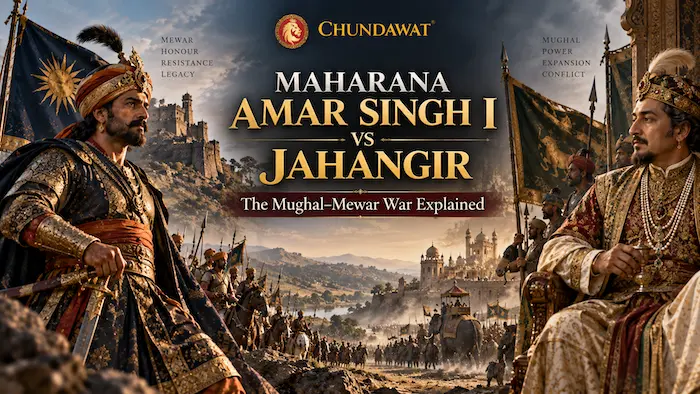
The conflict between Maharana Amar Singh I of Mewar and Emperor Jahangir of the Mughal Empire was one of the final major phases of the long Mughal–Mewar struggle.
The war had begun generations earlier and had continued through the reigns of several Mughal emperors and Maharanas. When Amar Singh I succeeded Maharana Pratap in 1597, Mewar remained independent but was under sustained military pressure from the Mughal Empire.
Jahangir, who became Mughal emperor in 1605, made the subjugation of Mewar an important objective of his early reign. Several Mughal armies were sent against Mewar, while Amar Singh continued the resistance inherited from his father.
The conflict eventually ended not with the complete conquest of Mewar, but with a settlement in 1615 between Amar Singh I and Jahangir. The agreement allowed Mewar to retain considerable internal autonomy while accepting Mughal suzerainty under specific conditions.
The war is therefore important not simply as a military confrontation between two rulers, but as a turning point in the political history of Mewar and the Mughal Empire.
Who was Maharana Amar Singh I?
Maharana Amar Singh I was the ruler of Mewar from 1597 to 1620 and the eldest son and successor of Maharana Pratap.
He inherited a kingdom that had spent decades fighting the Mughal Empire. Much of Mewar's territory had been devastated by prolonged warfare, while the Mughal Empire possessed considerably greater resources in manpower, revenue, and military organization.
Amar Singh nevertheless continued the policy of resistance for many years.
Rather than seeking a conventional open-field war against the vastly larger Mughal armies, Mewar relied heavily on the difficult terrain of the Aravalli region, fortifications, mobility, and local resistance.
His reign is therefore closely connected with the final stage of the Mughal–Mewar conflict.
Who was Jahangir?
Jahangir, born Prince Salim, became the fourth Mughal emperor in 1605, succeeding his father Akbar.
By the beginning of Jahangir's reign, the Mughal Empire had expanded across much of northern India. Mewar, however, remained one of the most important Rajput states outside direct Mughal control.
For Jahangir, bringing Mewar to an acceptable political settlement was both a strategic and symbolic objective.
The unresolved conflict also represented a continuation of the struggle that had begun during Akbar's reign, particularly after the Mughal siege and fall of Chittorgarh Fort in 1568 and the subsequent epic resistance led by Maharana Pratap.
Why did Maharana Amar Singh I and Jahangir fight?
The conflict was rooted in the longstanding struggle over Mewar's political independence.
The Mughal emperors sought to establish imperial authority over the major Rajput states, while the rulers of Mewar traditionally defended their sovereignty.
The issue was not simply territory.
Mewar's rulers had a distinct political position among Rajput dynasties, and submission to the Mughal emperor carried significant political implications.
When Amar Singh inherited the throne, he inherited this unresolved conflict.
The Mughal objective was to bring Mewar into the imperial political system. Amar Singh's objective was to preserve Mewar's independence and the authority of the Sisodia dynasty.
Maharana Amar Singh I vs Jahangir: The War Begins
The most intense phase of the conflict developed during Jahangir's reign.
Jahangir initially entrusted military operations against Mewar to his son Prince Khurram, the future Emperor Shah Jahan, after earlier Mughal campaigns had failed to force Amar Singh into submission.
The Mughal strategy increasingly focused on sustained military pressure rather than relying on a single decisive battle.
Mughal armies entered Mewar repeatedly, targeting strategic locations, agricultural areas, and routes that supported the resistance.
Mewar's response was shaped by its geography.
The rugged Aravalli Mountains made conventional conquest difficult. Amar Singh's forces could exploit narrow passes, forests, hills, and fortified positions to avoid fighting the Mughal army on unfavorable terms. The Chundawat Rajputs, holding the traditional vanguard (Harawal) of Mewar's army, fought ferociously across these mountain passes to protect the realm.
Major Mughal Campaigns Against Mewar
Several Mughal campaigns were launched against Amar Singh during the early seventeenth century.
The campaigns demonstrated the enormous disparity in resources between the two sides.
The Mughal Empire could mobilize large armies and sustain long campaigns, while Mewar had suffered heavily from decades of warfare.
Yet military superiority did not immediately produce political submission.
Mewar's terrain and defensive strategy continued to make the conflict costly.
The Mughal campaigns gradually placed increasing economic and military pressure on Mewar, however, making it more difficult for Amar Singh to maintain the prolonged resistance of the previous generation.
Prince Khurram and the Final Mughal Campaign
One of the most important developments came when Jahangir placed Prince Khurram in command of the Mughal effort against Mewar.
Khurram approached the campaign with a strategy designed to place sustained pressure on the resources of Mewar.
Instead of simply attempting to destroy Amar Singh's army in one decisive confrontation, the Mughal forces advanced into Mewar and disrupted the economic foundations that supported continued resistance.
The campaign eventually convinced Amar Singh that continuing the war indefinitely would impose severe costs on his kingdom and population.
This created the conditions for negotiations.
How did Mewar resist the Mughal Empire?
Mewar's resistance depended on several interconnected advantages:
1. Aravalli terrain
The mountains and rugged landscapes of Mewar made large-scale military operations difficult for imperial armies.
2. Fortifications
Mewar possessed an intricate network of forts and defensive positions that controlled strategic mountain routes and valleys.
3. Mobility
Rajput forces could maneuver through terrain that was virtually impassable for large imperial baggage trains and heavy artillery.
4. Local support
Resistance depended heavily on tribal communities such as the Bhils and local feudal nobility who sustained the Maharana's forces with supplies and intelligence.
5. Avoidance of unnecessary open battles
Mewar could not match the Mughal Empire's resources in a prolonged conventional war of attrition, so strategic conservation of manpower was critical.
This approach helped Mewar preserve its political identity for decades despite repeated imperial offensives.
Did Maharana Amar Singh I defeat Jahangir?
No. Maharana Amar Singh I did not defeat Jahangir in a decisive military victory.
Likewise, Jahangir did not completely conquer and annex Mewar in the manner of a straightforward military conquest.
The conflict ended through a political settlement in 1615.
This distinction is important because the Mughal–Mewar conflict is sometimes presented as though one side simply defeated the other.
The reality was more complicated.
Mewar remained capable of resisting, but the prolonged war had placed enormous pressure on the kingdom. The Mughal Empire, meanwhile, had the resources to continue military operations indefinitely.
The eventual settlement represented a compromise between these realities.
The 1615 Settlement Between Mewar and the Mughals
The conflict finally moved toward settlement in 1615.
Maharana Amar Singh accepted Mughal suzerainty under terms that were considerably less humiliating than the complete political submission demanded from some other Rajput rulers.
Among the important provisions was the recognition of Amar Singh's position as ruler of Mewar.
Mewar also retained considerable internal autonomy.
Unlike other Rajput rulers integrated into the Mughal imperial nobility, Amar Singh himself was not required to personally attend the Mughal court.
His son, Karan Singh, however, entered Mughal service and represented Mewar at court.
The settlement therefore brought an end to the long armed conflict while allowing the Sisodia dynasty to continue ruling Mewar.
What did Maharana Amar Singh I gain from the treaty?
The settlement did not preserve complete independence in the earlier sense.
However, it allowed Mewar to retain important elements of its political and dynastic identity:
- The Sisodia ruler continued to govern Mewar autonomously.
- The Maharana was exempted from personal attendance at the imperial Mughal court.
- No matrimonial alliance was forced upon Mewar, unlike other Rajput states.
- Chittorgarh was returned to Mewar (with the condition that its fortifications would not be repaired).
- For a kingdom exhausted by decades of total warfare, this represented a practical accommodation that prevented direct annexation.
What did Jahangir gain?
For Jahangir, the settlement was a significant political achievement.
The Mewar problem had remained unresolved since the time of Akbar.
Bringing Amar Singh into a relationship of Mughal suzerainty allowed Jahangir to claim the successful conclusion of a conflict that had resisted earlier imperial efforts for half a century.
The settlement also strengthened Mughal authority across Rajputana and removed one of the most important remaining centers of armed Rajput defiance.
Maharana Amar Singh I vs Jahangir: Who Won?
This question has no simple one-word answer.
Militarily
The Mughal Empire held the decisive advantage. It possessed greater manpower, financial resources, artillery, cavalry, and logistical capacity.
Politically
The outcome was more balanced. Jahangir achieved Mughal suzerainty over Mewar, which was a major imperial objective. But Amar Singh preserved the Sisodia dynasty's rule over Mewar, retained internal authority, and avoided complete annexation.
Historically
The 1615 settlement can therefore be understood as a negotiated Mughal victory combined with substantial concessions to Mewar. It ended the war without erasing Mewar's distinct political identity.
Amar Singh I vs Jahangir: Key Differences
| Feature | Maharana Amar Singh I | Emperor Jahangir |
|---|---|---|
| Role | Ruler of Mewar | Mughal Emperor |
| Dynasty | Sisodia Rajput | Timurid-Mughal |
| Objective | Defended Mewar's autonomy & honor | Sought Mughal suzerainty over Mewar |
| Strategy | Relied on Aravalli terrain & guerrilla tactics | Commanded a vast imperial military system |
| Lineage Context | Inherited the resistance of Maharana Pratap | Continued Akbar's unresolved Mewar policy |
| Resources | Faced severe demographic and economic limitations | Possessed vast empire-wide tax revenues |
| Treaty Outcome | Preserved Sisodia rule without personal court attendance | Secured recognized Mughal political supremacy |
Maharana Pratap and Amar Singh I: What Changed?
It is important to understand Amar Singh's reign in relation to his father, Maharana Pratap.
Pratap had refused to accept Mughal supremacy and spent much of his reign resisting the empire following the Battle of Haldighati.
Amar Singh continued this resistance for nearly two decades after inheriting the throne in 1597.
But the circumstances had changed.
Mewar had experienced decades of non-stop warfare, its agriculture was devastated, and the Mughal Empire remained overwhelmingly powerful.
Amar Singh eventually chose negotiation.
This should not be interpreted as an abandonment of his father's legacy, but rather as a pragmatic response to save his people and kingdom from total demographic destruction.
Was the 1615 Treaty a Surrender?
Calling the 1615 agreement simply a surrender oversimplifies the historical situation.
Mewar did accept Mughal suzerainty, which was a major concession.
However, the settlement also preserved the Sisodia dynasty's authority over Mewar and included terms that distinguished Mewar's position from that of many other Rajput states.
The agreement can therefore be better understood as a dignified political settlement following a prolonged and costly conflict. The Maharana retained significant internal authority, while acknowledging the superior position of the Mughal emperor.
What Happened to Maharana Amar Singh I After the War?
After the settlement, Amar Singh was deeply affected by having to yield suzerainty and gradually withdrew from active political affairs, retiring to Nau Chauki near Udaipur.
His son Maharana Karan Singh II took charge of state administration and formally succeeded him upon his death in 1620.
The political relationship established with the Mughal Empire continued during subsequent reigns, while Mewar retained its distinct cultural and dynastic identity.
The end of the war marked a new phase in Mewar's history: instead of constant active warfare, the Sisodia rulers focused on rebuilding their state, patronizing arts such as Mewari miniature painting, and developing royal architecture.
Legacy of the Mughal–Mewar War
The conflict between Amar Singh I and Jahangir represents one of the most important transitions in the history of Mewar.
For generations, the Sisodia rulers had resisted Mughal expansion.
Under Amar Singh, that resistance eventually transformed into a negotiated political relationship.
The war also demonstrates an important feature of medieval Indian statecraft: military conflicts did not always end with total conquest or annihilation.
The 1615 settlement allowed the Mughal Empire to establish political supremacy while enabling Mewar's ruling dynasty to survive and retain substantial internal authority.
The legacy of the conflict therefore lies not only in battles but also in the political compromise that followed them.
Maharana Amar Singh I vs Jahangir Timeline
| Year | Event |
|---|---|
| 1597 | Amar Singh I succeeds Maharana Pratap as Maharana of Mewar |
| 1605 | Jahangir becomes Mughal emperor after Akbar's death |
| 1606–1612 | Repeated Mughal expeditions sent to Mewar meet stiff Rajput resistance |
| 1613–1615 | Prince Khurram leads major Mughal operations against Mewar |
| 1615 | Amar Singh I and Jahangir conclude the historic peace settlement |
| 1620 | Amar Singh I passes away; Karan Singh II succeeds to the Mewar throne |
Frequently Asked Questions
Who was Maharana Amar Singh I?
Maharana Amar Singh I was the eldest son and successor of Maharana Pratap and ruled Mewar from 1597 to 1620. He continued Mewar's resistance against the Mughal Empire before reaching a settlement with Jahangir in 1615.
Who was Jahangir?
Jahangir was the fourth Mughal emperor, ruling from 1605 to 1627. He continued the Mughal effort to establish imperial authority over Mewar.
Did Amar Singh I fight Jahangir personally?
The conflict was primarily conducted through military campaigns involving Mughal commanders and princes rather than a single personal battlefield confrontation between Amar Singh and Jahangir.
Who led the Mughal campaign against Amar Singh?
Prince Khurram, the future Mughal emperor Shah Jahan, played the leading role in the final major Mughal campaign against Mewar.
When did the Mughal–Mewar war end?
The major conflict between Mewar and the Mughal Empire ended with a settlement in 1615 between Maharana Amar Singh I and Jahangir.
Did Mewar become part of the Mughal Empire?
Mewar accepted Mughal suzerainty after the 1615 settlement, but the Sisodia dynasty continued to rule the kingdom with substantial internal autonomy.
Did Amar Singh I surrender?
Amar Singh accepted Mughal suzerainty, but describing the agreement simply as an unconditional surrender is misleading. The settlement included important concessions that preserved the position of the Mewar ruler and dynasty.
Was Maharana Amar Singh I defeated by Jahangir?
The Mughal Empire achieved its objective of securing Mewar's submission to imperial suzerainty, but the outcome was a negotiated settlement rather than the complete conquest and annexation of Mewar.
What was the 1615 treaty?
The 1615 settlement established a new political relationship between Mewar and the Mughal Empire. Amar Singh accepted Mughal suzerainty while retaining his position as ruler of Mewar, and his son Karan Singh entered Mughal service.
What is the difference between Maharana Pratap and Maharana Amar Singh I?
Maharana Pratap is best known for his prolonged resistance to Mughal expansion, while Amar Singh I continued that resistance before eventually accepting a political settlement with Jahangir in 1615.
Conclusion
The story of Maharana Amar Singh I vs Jahangir was not a simple contest between a Rajput ruler and a Mughal emperor.
It was the final major chapter of a struggle that had shaped Mewar for generations.
Amar Singh inherited Maharana Pratap's resistance but also inherited a kingdom weakened by prolonged warfare. Jahangir, meanwhile, commanded one of the most powerful empires in early modern India and was determined to resolve the long-standing Mewar question.
After years of military pressure, the two sides reached a settlement in 1615.
The Mughal Empire gained political supremacy over Mewar, but the Sisodia dynasty survived and continued to rule. In this sense, the settlement represented both Mughal imperial success and Mewar's dynastic survival.
The conflict ultimately transformed the relationship between Mewar and the Mughal Empire—from generations of open warfare to a new political accommodation.